Assistants, automation and training — implemented with human oversight. We work with UAE operations, customer-service, sales and leadership teams on one recurring process at a time, from a written scope through to a documented handover.
Fixed-scope starting points priced in AED, with inclusions and exclusions in writing
Approved sources only — no answers invented from outside your content
A person approves anything your team classes as sensitive
Based in Sharjah, United Arab Emirates · 052 483 2257 · management@axiomora.online
Workflow record
Supplier invoice → finance system
One document type
Fields in scope
5 defined
Supplier nameMatched to vendor listok
Invoice numberRead from headerok
Invoice dateRead from headerok
Total incl. VATCross-checked to linesok
Purchase orderNo PO foundreview
Confidence thresholdagreed with you at design stage
Posted automaticallyReview queueRejected
Audit trail
09:14Document received from shared inbox
09:14Classified: supplier invoice
09:145 fields extracted · 1 below threshold
09:31Reviewed and approved by finance
Human review point
Start With A Problem
Where teams lose hours every week.
We start with the process — not the technology. In the first session we look at what a task actually involves today: who touches it, how often it runs, where it stalls and what has to be checked before anything is sent or filed.
If a process is too varied, too sensitive or too low-volume to justify automation, we will say so before you spend anything further.
Repetitive customer questionsThe same enquiries answered manually across email, chat and phone.
Manual data entryDetails re-keyed between forms, spreadsheets and core systems.
Slow document processingInvoices, forms and contracts read and checked one at a time.
Information across many systemsStaff searching several tools to answer a single question.
Delayed sales follow-upEnquiries losing momentum while they wait for an owner.
Time-consuming reportingRecurring reports rebuilt by hand every week or month.
Core Solutions
What we build.
Four practice areas, delivered as scoped engagements rather than open-ended projects. Most clients start with one workflow in one area and expand only once it is running reliably.
These are narrow, high-repetition tasks with a clear owner — the kind of work that is straightforward to measure and safe to review. Most engagements begin with one of them rather than a department-wide rollout.
Support FAQ assistantApproved answers, escalation to an agent
Lead qualificationStructured capture before hand-off
Policy search assistantAnswers cited from internal documents
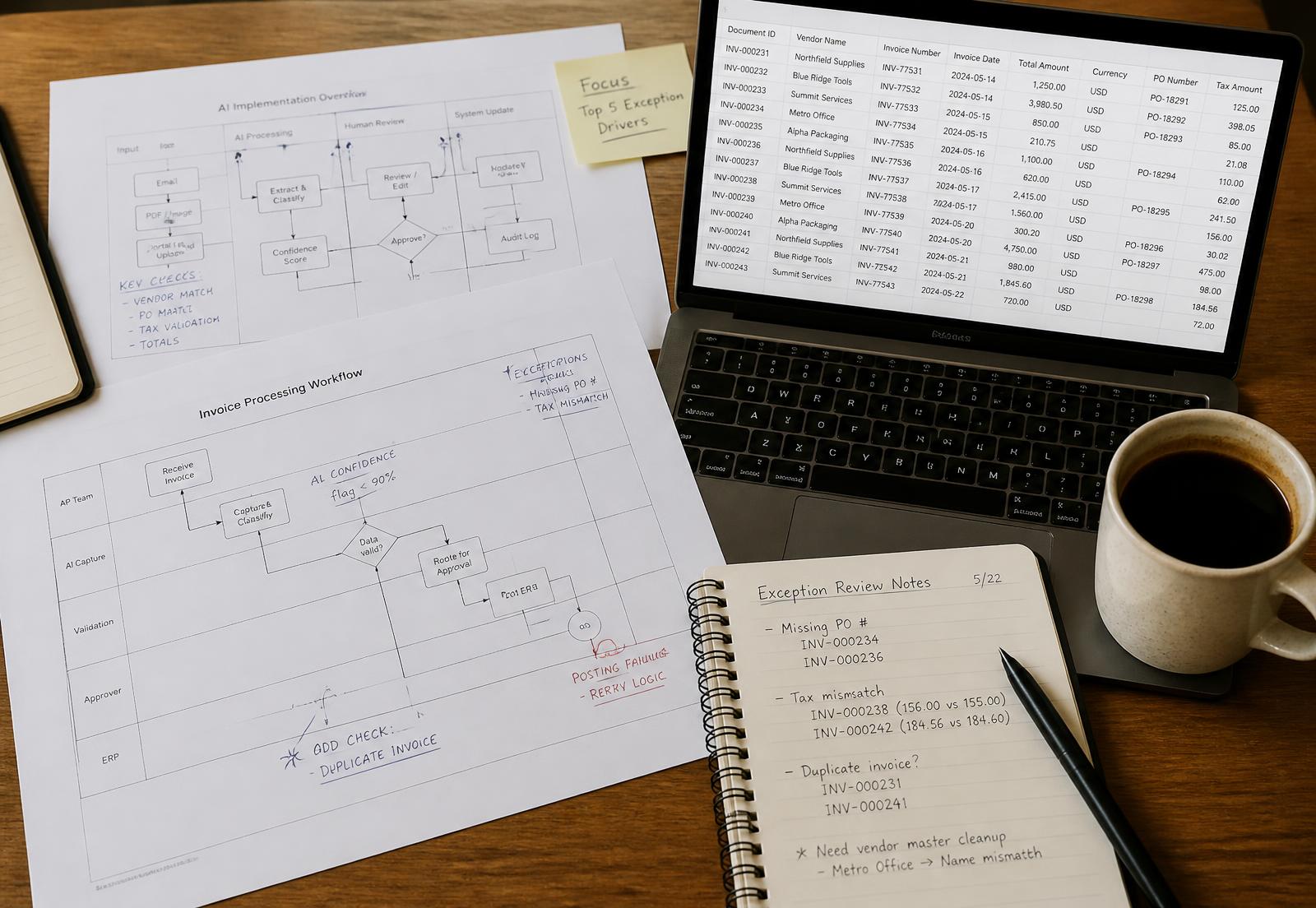
Invoice extractionFields checked before posting
CV screening supportShortlist support, decisions stay human
Email action summariesActions drafted for review
Sales follow-upReminders and drafted replies
Property enquiriesListing questions with routing rules
Travel enquiriesItinerary questions and hand-off
Supplier documentsClassified and matched to records
Management reportingRecurring summaries from your data
Service-desk assistantTicket triage with review steps
How We Work
How an engagement progresses.
Each stage has a written output and a decision point. You can stop after any stage, and nothing moves to build until the scope, the controls and the commercial terms are agreed in writing.
01
Discovery
One process reviewed with the people who run it: inputs, volumes, exceptions and where time is lost.
02
Assessment
Suitability, data sensitivity and system access considered, with an honest view on whether to proceed.
03
Design
Future-state workflow drawn up with approved sources, review points and escalation rules.
04
Workflow Validation
A limited working version tested against real examples so your team can judge it before committing.
05
Implement
Configuration, integration with agreed systems, user testing and documented handover to an owner.
06
Optimise
Reviews after launch to adjust thresholds, expand approved content and handle new exceptions.
We do not deploy systems that make final decisions on your behalf. Every workflow we implement has a named owner, a defined set of sources it may use, and a documented point at which a person approves, edits or rejects what the system has produced.
Human approval
Actions your team classes as sensitive require sign-off before they leave the system.
Confidence checks
Uncertain results are held back and routed to a reviewer rather than sent automatically.
Role permissions
Who can view, approve and change a workflow is agreed with you and enforced per role.
Approved sources
Answers are drawn from the documents and systems you have explicitly approved.
Customer submits an enquiry through an agreed channel.
02
Interpretation
Classified against approved knowledge and the topics in scope.
03
Action
Fetch an approved answer or trigger a permitted system action.
04
Confidence check
Checked against the threshold agreed during implementation.
05
Human review
Sensitive or uncertain requests go to the service desk with context attached.
06
Response
Reply issued; the decision, source and reviewer are logged to the audit trail.
Thresholds, escalation rules and the systems involved are agreed with you before build.
Industries
Built for how your team works.
The technology is similar across sectors; the operational detail is not. Each page sets out the processes teams in that sector usually bring to us first and the controls that tend to matter.
What the process looks like today, what we change, and the point at which a person still decides.
Logistics and freight
Delivery order intake from email
Today
Booking requests arrive as email text, PDFs and spreadsheets. Coordinators re-key consignee, weight, incoterms and reference numbers into the TMS, usually twice.
What we build
An intake workflow that reads the agreed fields from each format, normalises units and references, flags anything missing and creates a draft booking for confirmation.
Who decides
The coordinator confirms the draft before it becomes a live booking. Rate and customs decisions are never automated.
Shared inboxTMSException queue
Real estate
Portal enquiry triage and follow-up
Today
Enquiries land from several portals and WhatsApp. Agents answer whoever they see first; budget, area and availability are re-asked in every conversation.
What we build
Enquiries are captured in one structure, matched to available inventory, assigned an owner with a follow-up task, and answered from listing facts the brokerage has approved.
Who decides
The agent approves any pricing, availability or viewing commitment before it is sent to the client.
PortalsCRMWhatsApp Business
Clinics and healthcare admin
Insurance paperwork preparation
Today
Admin staff assemble approval requests by hand, checking policy numbers, eligibility fields and supporting documents against each insurer's format.
What we build
A document workflow that extracts the required fields, checks each submission pack for completeness against the insurer checklist and queues anything incomplete.
Who decides
A named administrator reviews and submits. Clinical content and eligibility judgements stay with qualified staff.
Clinic systemInsurer portalsReview queue
What You Receive
Eight artefacts, handed over in writing.
An implementation is not finished when the workflow runs. It is finished when your team can operate, audit and change it without us in the room.
A written scope of work with inclusions, exclusions and assumptions
A process map of the workflow as it runs today, agreed with your team
The configured workflow in your own environment and accounts
A field, rule and threshold specification you can audit
An exception and escalation model naming who reviews what
Test results against real cases taken from your operation
A plain-language operating guide plus a recorded handover session
A change log and named owner for every subsequent adjustment
Scoping
What a well-scoped AI workflow includes
Most AI projects fail on scope rather than technology. Before any build begins we write down the task, the sources the system may use, where a person must approve, and what happens when the system is unsure.
01
A defined business task
For example, routing routine enquiries, extracting agreed fields from documents or preparing an approved draft response.
02
Approved sources and boundaries
The workflow is configured around information, systems and actions that the client has approved.
03
Human review where needed
Teams decide where approval, escalation and exceptions should sit before implementation.
04
Documented handover
The agreed workflow, ownership and support arrangements are recorded before launch.
Use Cases
How a scoped workflow looks.
Three of the workflows we implement most often. Each follows the same shape: a narrow task, approved sources, a review step and a recorded outcome. Client names and figures stay confidential.
Customer Support
Approved-content support assistant
Routine enquiries are answered only from content the client has approved. Anything outside that set, or below the agreed confidence threshold, is routed to an agent with the conversation attached.
Approved answer library
Escalation rules per topic
Full conversation log
Document Workflow
Form extraction with human review
Agreed fields are extracted from recurring documents and presented for checking before anything is written to a system of record. Rejected extractions stay visible so patterns can be corrected.
Defined field set
Reviewer approval before posting
Exception queue
Sales Workflow
Website enquiry to CRM
Enquiries are captured in a consistent structure, checked for completeness and passed to the CRM with an owner and a follow-up task. Commercial decisions stay with the sales team.
Structured capture
Owner and follow-up assignment
No automated commitments
Project Packages
Package inclusions and prices.
Fixed-scope starting points with written inclusions, exclusions and what we need from your team. Larger implementation work is quoted from an accepted scope of work rather than sold as a package.
Package 01
Workflow Consultation
AED 1,250
A structured working session on one operational process: what it involves today, where time is lost, whether AI assistance is appropriate and which controls it would require.
One 90-minute session, remote or at an agreed UAE location
Pre-session questionnaire covering inputs, volumes and systems
Automation suitability discussion for one process
Written summary of what was discussed and what we recommend next
Payment:
Paid in full at booking.
Timing:
Scheduled within the working week following payment confirmation
Support:
Follow-up questions by email for 7 days after the session.
Assessment and mapping of one approved operational workflow, including the current process, decision points, exceptions, required controls and a recommended future-state design.
Stakeholder discussions with the people who run the process
Current-state process mapping
Input, output and decision-point identification
Exception and risk register
Payment:
Confirmed in the written scope before work begins.
Timing:
Confirmed in writing before booking.
Support:
Included for the duration of the workshop engagement only.
Configuration of one approved workflow: instruction and decision design, exception handling, human-review queues, testing against agreed scenarios and handover to your team.
Workflow architecture and decision rules
Prompt and instruction design
Exception and confidence routing agreed with you
Human-review checkpoint design
Payment:
Deposit on signature of the scope, balance per the written payment schedule.
Timing:
Confirmed in writing before booking.
Support:
Correction of defects raised during the acceptance period defined in the scope.
If something here is not covered, ask during the consultation and we will answer it in writing.
Do you replace staff with AI?
No. We scope assistance around specific repetitive tasks and keep a person accountable for outcomes. Where a task involves judgement, risk or a commitment to a customer, the system prepares work and a person approves it.
Where does the system get its answers?
From sources you approve — your documents, policies, records and connected systems. If a question falls outside that set, the workflow is configured to escalate rather than improvise an answer.
What happens to our data?
Data handling, retention and access are agreed in writing before implementation and set out in our privacy and data-processing pages. We ask for non-sensitive samples during discovery wherever that is sufficient.
How long does an engagement take?
A consultation is a single session. Discovery and design work is scheduled around your team's availability. Implementation timelines depend on scope and system access, and are confirmed in the scope of work rather than estimated here.
How is the work priced and paid for?
Fixed-scope items are priced in AED and can be booked and paid online. Implementation work becomes payable only from an accepted scope of work with an agreed deposit. VAT is applied at the prevailing UAE rate where it applies.
Can we start small?
That is what we recommend. One workflow, one owner and a clear review step is usually enough to judge whether wider rollout is worth it.
Start With One Workflow
Bring us a process that costs your team time.
Come to the first session with one recurring process, a rough sense of how often it runs and who currently handles it. We will tell you whether AI assistance is appropriate — including when it is not.